Showing posts with label Jake Fillery. Show all posts

Tuesday, 19 April 2016

Male Audience for Horror

Males are more likely to be fans of horror films than girls, and this is the stereotypical thrill seek and enjoyment of seeing gore and violent acts towards other humans. 
The disturbing scenes that they watch frighten them, but the fact that it is fictional changes them from being real, as we have a sense of control over what is real and what is not from true acts of violence, and ones in films. Zillman and his colleagues exposed 36 male and 36 female students to a horror movie in the presence of someone of the opposite sex. Men enjoyed the film more when they were with a distressed woman, and women enjoyed in more when with a mastering man. 
It also links to gender socialization from a quote from Sparks; “Men often like [scary films] as date movies because women are more likely to seek physical closeness when they’re scared, and men can show off their strength and bravery,” Cantor said. (This is aptly called “the cuddle effect.”)

Males tend to like this genre more because it makes them seem brave if they show no fear and simply laugh at the gore and scary themes, because they do not want to be seen as a coward, and more dominant. 

Seeing someone get possessed, or getting cut in half is more enjoyable to watch when you have no fear of it happening to you, but some people can be paranoid that they are afraid of what they are watching in case it could happen to them. 

In a study, more women chose scares over mindless violence, this is proof that men like to prove to people that nothing scares them or grosses them out, and they are fearless. 

Master Post: Evaluation Question Blogs

1) In what way does your product use, develop or challenge forms and conventions of a real media product?
K:
O:
L:
J:
 
2) How does your media product represent a particular social group?
K:
O:
J:
 
3) What kind of media institution might distribution your media product and why?
L:
O:
K:
 
5) How did you attract / address your audience?
O:
L:

6) What have you learnt about technologies from the process of constructing this product?
K:
O:
L:
J:

7) Looking back at your preliminary task, what do you feel you have learnt in the progression from it to the full product?
K:
O:

Tuesday, 8 March 2016

Conventions of Female Victims

Women are not always victims, and they are often empowered. In films like Alien, it is the woman who survives and kills the alien threat, were her crew both male and female, die.

Directors such as Dario Argento ("If they have a good face or figure I would much prefer to watch them being murdered than an ugly girl or man) and Brian De Palma have expressed a preference for menacing or killing beautiful women in their films.

Tim O’Sullivan and co say that “the dumb blonde stereotype might include: blondness, seductive body language, strong makeup” This is supported in “Scream” by the character tatum Riley who gets killed in the most sterotypical way.

The book “Men, Women and Chainsaws” by Carol J Clover “A phychokiller who slashes to death a string of mostly female victims, one by one, until they are subdued or killed, usually by the one girl who has survived.”

Results show that of the males asked, there was an equal split between favouring attractive model-like lead characters and preferring more believably everyday characters, however there is an uneven split for the females that were asked, the majority favouring attractive leads.


Wendy in The Shining was not attractive compared to the characters in the teen movie horrors, showing a clear difference between psychological and slashers, where slasher victims have pretty female victims, and psychological focuses more on the acting ability. 

Conventions of Mystery in Horror

Horror films are well known for their mystery and suspense that they create in their scenes, this usually begins in the opening credits, as the audience is left with a cliff hanger that they only have the answers to near the end of the climax of the film.


The way in which conventions are commonly placed in horror is done with the lighting, and how it is dark, and behind the character to show them, and show their fear, and with this position of lighting you cannot see the killer who is behind them, ready for a jump scare, but before this happens there is a lot of suspense to get you drawn into the scene.


setting usually consists of some place that the killer is attracted to due to past reasons, and the mystery behind this is why they like the place they stay in, whether it be a woods, or a basement in which they commit their acts of murder on. The answers to why they are drawn to this place add to the mystery, and are only answered as the film progresses, leaving you to wonder from the opening scene in which most mysteries come from to keep your attention.

The third conventions is the camera angles, which are simple, and stick to overhead shots to show if something is behind them. Depth of field is also used to show if there is a monster behind them, and blur the scene to just show a shadow.

Thursday, 25 February 2016

Mise-en-Scene of Hannibal (TV Series)

Please note that the following content may disturb or sicken others due to the violence of the scenes:

The TV show Hannibal, based off of the events of Red Dragon, Silence of the Lambs, and Hannibal is a TV show that ended, but was on Sky Atlantic and stared Mads McKenzie as Hannibal Lecter, and had beautiful visuals, beautiful, yet haunting with how disturbing the scenes were. What can you expect about a show about psychopaths and sociopath killers, and one being a cannibal? The TV show had great mise-en-scene and below I have chosen three of the best ones to choose from. The scenes are both horrific, and horrifically beautiful, and Will Graham is a detective who has to analyse the scene to find out how they died, and who did it, and it is pure genius in how the crew set up the mise-en-scene of the scene so that the characters do not miss anything, which means we do not miss anything too. We deconstruct the scene as the character Will does, and we cannot help but see how gorgeous yet disgusting and unsettling the visuals are with their artistic ways. 


The first scene that I have chosen to deconstruct is the killer who creates "angels" as his victims. Already you can see what I meant by horrifying yet beautiful, how they are posed and how the scenes are done. They are chilling, yet to the killer it is art. In the scene you can see the effort put into it by the team who build the scenes, how the back is opened up and held up like angel wings with the skin and muscle of their back, propped with strings, and their hands tied together to look as if they are praying, and this scene shows the great mise-en-scene that keeps us focused on the scene, and is great for films because it is something that you will not forget for a while.

 The next seen has great mise-en-scene with even more disturbing scenes of the human totem pole, which is made up of many naked and mutilated corpses, held together with string and wire and each body positioned on top of one another to create this totem pole of dead bodies.
This one, probably the most disturbing for the fact that this man had a cello forced down his throat, and a man used his vocal cords to play the cello on a theater stage. You can see his skin, open wind pipe and the muscle under neath the skin, serious detail to the remarkable art which is practical effects.

The detail of the scenes which go into the series of 'Hannibal' is wonderful, and something our group should be inspired to do to make sure there is always something in the frame that the audience can pause and notice and try to think of what it is in the scene, and what importance it does play. 

Inspiration for Locations

The cabin in 1981's "Evil Dead" was inspirational for other horror films like the recent "Cabin in the Woods" This was the original cabin, which was in the woods, and the entire film was inside this cabin, and we took inspiration from this by keeping the main parts of our scene by keeping them inside a cabin, and only seeing the outside in the later part of the opening scene towards the end, and just like Evil Dead, it was shot in two different locations, as Evil Dead manipulated audiences into thinking the cabin they used in the woods was the same cabin they used to film inside, which it actually wasn't, and we have done the same with the cabin being o where near the field that we used for the killer to run after the victim. The reason that we chose a small place like a cabin was because it would make sense for the killer's hideout to have some history with their family, just like Evil Dead where the owner was the owner of the book that could raise the dead, and their is unknown history with our killer and the lair that she tortures her victims in, which would of course be explained if this was actually a full film with an entire cast.
"The cabin burned down in 1982. All that remains is part of the fireplace, pieces of the tin roof and some of the foundation."


Transitions in our Student Made Opening Scene

In the post-production task of our student made production, the four of us worked together and took different tasks to get our production finished with all of our opinions on how it could be better in the mix. My task was transitions, and I think this task was an important one because it makes us feel like the character, especially in Point of View shots such as the opening one, where the lights flicker on, and the victim slowly opens her eyes. A blur fits well with her confusion to where she is, and how she has a concussion due to the head injury she sustained to get into that situation. There are many transitions to choose from, and we made sure that we put the right ones in, and at the right times. The logo for transitions are two triangles, parallel to each other with the tip of each on the right and left. They look grey too, and can be easy to differentiate from text, footage and sound. Transitions are put between the clips, and can be extended and shortened which includes the speed of the transition, making it happen faster or slower, and can help change a scene, which has been done in films with the famous "Lucas Wipe", commonly used to change scene in Star Wars.
 This is a screenshot of what all the transitions are, and what we used mostly was blurs and cross dissolves, but there are many more to choose from so we had to find the right ones.


 This is an example of the transitions, as the screen is noticeably blurry as it focuses on the victim's point of view for a POV shot as she just wakes up, making the scene more effective with its shaking camera acting like a moving around head, and the blur representing her tiredness and aching head.

Camera Angles in 'The Thing' (1982)

One of the most haunting films in the 1982 horror film "The Thing" is the scene that can only be described as the defibrillator scene. A truly disturbing experience for a first viewing, and makes you very cautious and paranoid about peoples stomachs. The camera angles used in this film do not hide the horror, they seek it and force you to watch it, and this scene is no exception with its use of practical effects that are chilling. The first shot is a mid shot which shows the characters over the man's body who needs medical attention. The shot then changes to close up on the man's stomach and the doctor's hands, holding defibrillators. The "dead man"'s stomach then opens up, and he has teeth in his stomach, which swallows the doctor's arms, tearing them off and swallowing the defibrillators. The way the shot stays focused on the abyss inside his stomach, and the horrific mouth with sharp teeth that bite off the doctor's hands is truly horrifying, and it does not care to show the reactions of the other characters. It wants the viewers to be disgusted and truly horrified, like they were there just as the other characters were, but you get closer, seeing his arms ripped through the socket and the bones tear off with blood flooding out. It also uses examples of panning, from where it shows the true monster's neck, waggling, and pans up to show its horrific face and arachnid like arms, with many close ups of the monster to truly scare the audience.

Jake's Filming Evaluation

For our student made production, there was personal issues in the December of 2015 which halted me from turning up to shooting the student made production. Luckily, in early January of 2016, reshoots were needed in Gravesend for the killer's hideout scene, and thankfully I could attend to this one, and watched and helped my group. I cannot compare what was different to the original shooting day and the new one, for I was only there for the reshoot, but I believe the progress was better for there was another person there for input, and it helped for me as a new member in the group to talk more to my peers and become more friendly and not alienated out of choices like what a certain shot should look like, and helped move along the process if there was a different camera angle agreed and it could be worked out to better improve our final production. There were no problems that I can think of when it came to filming, apart from limitations with what we could do in a small space and working environment for  shooting. Everything we did after this day was post production, like finding sound and editing the scenes together.

Lighting Experiments

Lighting is a huge part for making any production in media, and can affect the way something is viewed, and can have meanings behind how the lighting is done. For instance, lighting can be used to make someone look differently, like Demi Lovato, once photographed from the side with a bright flash made her into an internet meme that was called "Poot." and was mocked because of the way the light changed her face. I have used the realistic figure of Henry Caville's Superman to show how a face can look differently, with the same expression. The first picture makes him look as he is suppposed to, an ideal of Hope. He is seen as a symbol to strive towards, and looks up to be the Man of Tomorrow. The light is not artificial, meaning it is not the sun's light, but without seeing the lighting in frame it can look like it is the sun, and Superman looks like he is there to protect humanity and life itself. 


The next picture is a change of lighting, and makes Superman look like a killer, this is what I mean by how lighting changes the scene, and with this same expression and simple change of lighting, Superman looks like a murderer and someone who has the intentions of a mad man due to his face having light shined on it from his chin and up. His expression is evil, and looks like someone who is not willing to save humanity, and this is how lighting can be manipulated and experimented on to change the emotion of a scene. 


The next two pictures are of a statue of Batman holding up Joker by his purple blazer, and getting ready to drop him. The lighting is huge for this character, as he is dark and brooding, and as he says many times "I am the night." So it is obvious that his lighting must be in the dark, and not artificial, using light from bulbs and torches as well as the moonlight, and in the interrogation scene for The Dark Knight, the lighting used is small at the beginning and we are not even aware of Batman's presence until the lights come on. 
The picture on the left shows how lighting can ruin a scene. The tense moment before Batman beats the high hell out of the Joker is ruined by the brightness of the scene, and the picture on the right shows how lighting can make a scene more dramatic and effective, with light being lost and closed off in this scene as it looks like the presence of the caped crusader causes fear to replace light with darkness.


Head in a Jar Practical Prop

To make this prop, all I did was get a large jar that was filled with mince. The mince was not important, and was scraped into the food bin as soon as I got home. Once the jar was washed out thoroughly to clean it from the mince and juices, it was clean and see through, and I then typed in Google "Head in a jar picture" which after searching came up with the picture below, and I printed it off, 150% the size of A4 and rolled it inside of the jar to make the illusion of it being a 3D head. It looks better from distance, in dark light and different angles, and the reason for this is because the insides of the jar are narrower as it goes down, and its shape inside is different as it goes down, not letting the paper expand all the way and roll around without parts being missing from the inside. 


Costumes in a Student Made Production

For our student made production we went with a self made mask, which was a bloody sack that looked rather creepy in dim light, but my original idea was for a mask I already had, but it is better that we chose a self made one, for it was not already made by a company and with a self made item you can chose what you do with it. The original mask idea from me was something that came with the graphic novel 'Death in the Family'. This mask would probably be copyright though, as the rights are owned by DC Comics and Warner Bros. The mask is of the character The Joker, when he removed his own face and stapled it back on for sinister and a "new me" purpose. The reason I had this in mind is because in a dark room, the fact that it is joker might not be obvious, and we can always remove the annoying light green hair and hair cap, and just keep the mask and its strap. The sinister wide lip grin could have gone well with the lighting, and the eyes underneath the face would have looked creepy, but we could not use it as it may have looked ridiculous to some, or it would have been copyright for material we do not own. It was also very sweaty to wear, as it had limited space, and seeing was not the best, and it would often slip.

Location for Student Made production

In our student made production, the ending of our opening scene starts in a field, where the antagonist chases the tortured victim who had escaped. I live a few minutes away from a field, and took some pictures, but decided that it would be the wrong place to film this scene for many reasons.

The first reason was that it is a public field, in which some activities are very out of place for where the characters were prior to this scene, which was implied that the killer's hideout was on a field, and there is no "hideout" on this field, just objects used by dog owners to train their dogs.

The second reason is that it is right next to a residential area of mostly old people and families, so a child or an elderly woman looking out of her window to see a girl bruised with makeup, running barefoot from a disguised girl wearing a bloody sack over her head whilst chasing the victim with a hammer would cause some alarms, especially to people that might not understand, and it being a public place. 


Another issue is that the field is thick with mud, so it would be hard for the actors to run when they get their feet, and boots stuck in mud, also the sound would be just squelching due to the mud. 


The field has a lot of area, but there is a building with every turn, and it has no turns, it is simply a flat field with nothing interesting, not even long grass or trees in the way, or a path. 


 There is a forest area down below, but to get there, there are lots of stinging nettles which wouldn't be good to go through because of the actor being in bare foot, and even when they are down there, there is not much down, it is a few trees together, but you can  easily see out of the trees to a hospital and other buildings, as well as a busy road. 


Student Made Production Company

Here is the original image for my own production company that I had to make. I did not know how to make it a video, and did not have the software so I made it a picture, and it does not move. It would be a production company that stays on screen for a few seconds and leaves for something better. To make the image, I used a fake Oscar Statue, and placed it against the window, facing the light and took a picture with my phone, which has an iPhone 5s camera.
I then added text to it using Macromedia Fireworks. It was a "Century Gothic" font, and the size was 300, I placed it on the right, just near the right shoulder of the Oscar Statue and called it "Oscar Bait", also making the colour gold like the statue, a parody, if you will, of all the films that come out just to get Oscars. 

Editing of Silence of the Lambs

Silence of the Lambs is considered one of the best horror films of all time, and even earned five academy awards and was the first horror film to acheive an Oscar for Best Picture. The editing of this film has a few techniques, and especially in one of the most important scenes of the film. This scene is where Hannibal Lecter escapes, killing two guards, but the way that it is shot is remarkable, for the editing techniques are well done, and we cannot actually be certain that he has succsefully escaped his confiement until the ending scene, where it cuts as we see him inside of an ambulance, disguised as a prison guard, wearing his skin like a mask to hide  his identity, a clever and well thought escape that we watch with excitement, knowing the greatness of that scene, and how it boosted the film to Oscar worthy stardom. The reason I have chosen this scene to deconstruct for editing, is because of the way in which it is done, as it is edited so you do not follow Hannibal's path, you follow the events as the police do, so you do not know of what is actually happening in the scene because you are just -mas blind and ignorant as the police are, believing that they have the upper hand against this genius. The editing is the stage in which you have finished filming, and begin to put all the footage into an editing software in which you can add sound effects, msic and special effects to and make scenes chronological or the order in which you want to tell the story.
The scene starts off slow, there is no cross-cutting and the camera does not change, it stays as a continuos and tracking shot which follows the guards as they give Dr Lecter his food, but as he escapes, the editing changes to Match on Action, from two shots where Hannibal opens his mouth and the next shot in which he is biting off the face of the guard that gave him his food, and now becomes his food. The next shot is done with a different technique, as it is Cross Cutting, because the narrative cuts to Hannibal no longer there, as the camera slowly pans over to see the food left there, covered in blood from where Hannibal beat the guard to death. The sound in this scene is diegetic, and scarily does not fit with the scene. You would expect to hear horiffic music as you witness the scene, but instead you hear a beautiful melody of a piano. There is a jump cut to a different scene and now we see the perspective of the police as they watch the elevator come down to their floor, but mysteriously stop on the third floor. This is where we are held in suspence and fearful of what he is doing, and the way the editing is now done we do not know where Hannibal is, which holds for a more tense scene as we find out what actually happened, and when we understand and respect the brilliance of Doctor Hannibal Lecter because of this escape, made confusing and tense at the start because of the well done editing which  keeps us not knowing what is happening on how it does not follow the simple continuity editing and instead using a vast array of editing techniques.

Se7en Timeline


00:03 The film ‘Se7en’ begins with a quick shot of pages turning. Already, the audience is left in confusion as to what is happening; this is only the beginning of the psychological horror. The opening shot also shows the company that produced this film, small on the screen so you can focus on the screen details. Throughout this opening scene, there is a constant eerie sound that could be considered music, yet it repeats the same notes. From this shot in particular, we cannot read much information but we can see that maybe the book is there as the person is researching into what he wants to do.

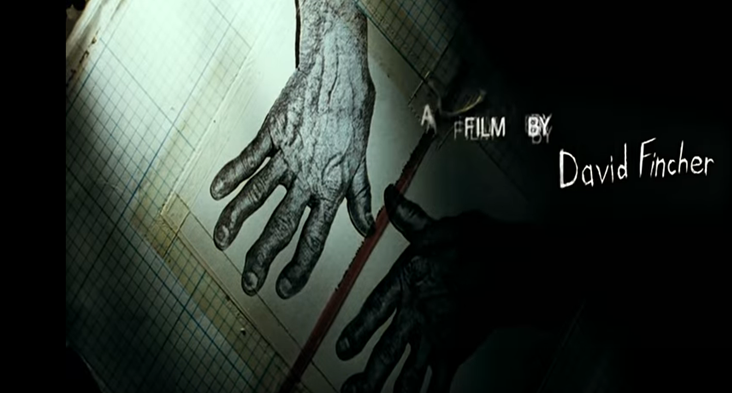
00:10 The next shot shows who the film is made by, and usually this is a big deal, because they are responsible for bringing the vision of the script to life on the big screen, and you want someone good, someone who people know and has a good record of films. What this shot has in it is a pair of drawn hands, so it brings the question as to why there are drawn hands in such detail. One possibility is that it is there to show it’s a surgery book and shows the nerves in hands? It adds to the list of questions in this thriller.


00:12 The next shot is a close up of a razor, it’s purpose is unknown but we can only presume it is for violence. More evidence for this comes in the next few shots, but this raises eyebrows in questioning as to why he may be doing this. What this makes us feel is a sense of uncomfortableness with the music as well as the mystery of what is happening.

00:13This shot shows us who the cast is in the film, and when a film has a cast of good and well known characters they usually become more popular and make more money.

00:15 The next shot things become more disturbing as the eerie noises become more high pitched as you see a quick second glimpse of the unknown man using a razor blade to slice off his fingertips, disturbing the audience on what he is planning, and maybe making them squeamish at the sight.

00:16 The next shot is an extreme close up of a razor blade. It is only a quick shot, so we have to pause it to see what is happening, but when we do we can see his fingers, and it might imply that he has taken off his fingertips, and never washes his hands and does not care for his physical appearance like most psychopaths. I think this is done well, it makes you think and can disturb audiences.

00:18 This shot shows us another one of the cast is in the film, and when a film has a cast of good and well known characters they usually become more popular and make more money.

00:24 This is the film title. It shows the name of the film and the way it is done is in a series of jump cuts and the words move and flash at you whilst the eerie noises continue.

00:29 This is another shot in the opening credits to show who the cast is, another famous actress.

00:34 This is another actor so people know who is in the film.

00:39 This shot shows a piece of film being cut. There is no reason that the audience could think of as for why, but if you look closely you can see some sort of written book, implying he is scrap booking his crimes. This is effective as it is a record of his mind, and who he thinks he is.

00:40 The next shot is darker, and shows the scissors again but this time cutting a picture and putting it into a journal of some sort. His fingers are plastered showing that he may have done something to them, confirming his removal of fingers.

00:43 The shot is continued with more pictures of what at first glance appears to be dead children photographed in black and white and now being placed within the messy and horribly done scrapbook of a supposed psychopath.
00:59 In this shot we see his handwriting, and how jumbled and messy it is. He begins to cross out words, but it is unknown as to what this word is because it is hard to read, especially upside down.
 
01:01 The character, known to be male because of his hands is now looking at ‘When you’re pregnant’ books. This may add question as to who the character wants to be, like Buffalo Bill from ‘Silence of the Lambs’.


01:08 These words if you look closely seem to be referring to sexuality and sex, as that is what some words show.

01:10 This gives credit to the casting directors, the people who chose who would be in the film. But the shot also includes a pen crossing out the eyes of a picture, and when that usually happens that is to show their identity or nothing, or that they will be killed.

01:18 This shot does not show much with what is in the scene apart from the words which shows the person who did the music for the film. If it is a famous composer then the film may make more money off of the soundtrack because they like the songs used. For instance; the composer Hans Zimmer is famous for his amazing work with ‘Interstellar’ and ‘The Dark Knight Trilogy’.


01:33 This shot is something for the more easily disturbed people, since this is a type of horror they must have some scenes which gross out the audience, and this one will do just that with a metal pole digging into a man’s skull as a form of old surgery, adding to the audience’s curiosity as to just what is happening.


01:45 Producers usually get an opening credits slot since they had an involvement in the film’s production.

01:50 This shot shows the mysterious man now threading his own journal together with string and a needle to keep it together. He has bandages around his fingertips showing how he has removed them with the razor in the previous shot. 

.